


Anne Hathaway: The Devil's in the Details
Anne Hathaway is talking about work-life balance, a concept that actresses were asked about for decades and their male counterparts never were.

It may have reached its apex (or nadir, depending on how you look at it) in 2013, when Sheryl Sandberg told every woman to lean in, that they could “have it all”, which mostly meant having a family and a full-throttle career and no time to feel adequate at any of it. For a while, everyone seemed to agree that this was a good thing. In other words, it’s a very millennial notion for a very millennial film star to be contemplating, having just reprised her most millennial role, as plucky Andy Sachs, in the highly anticipated The Devil Wears Prada 2.
It has been 20 years since Hathaway starred in the original The Devil Wears Prada as a recent graduate with serious journalistic aspirations who takes a job at the fictional fashion magazine Runway as an assistant to the imperial editor-in-chief Miranda Priestly (played meme-ably by Meryl Streep), despite her disdain for something so frivolous as fashion. The movie made her the patron saint of earnest millennial ambition, and Hathaway returns to Andy Sachs at a time when both she and the culture have outgrown the fantasy of having it all.
Hathaway is now 43. She and her husband, the producer Adam Shulman, have been married for 13 years and have two young boys, ages six and 10. She has made about 50 films, some of them giant and blockbuster-y, some of them critically revered, and some of them – as she herself put it recently – “weird” or that “no one saw”, such as 2017’s Colossal. One of them, 2012’s Les Misérables, earned her an Oscar for Best Supporting Actress for her performance as Fantine. She tells me about having made a “conscious shift” in recent years to stop living her life as a “stressed person”, which coincided with her decision to stop drinking.
“Before, there was this focus that was really uncompromising and uninterrupted,” Hathaway says. “And I just can’t tell you anymore what life is like without kids, but kids interrupt you all the time.” Balance, she explains, is too fragile a concept. “My friends and I talk about it a lot, and we actually feel very defeated by the concept of balance,” she says. “If the weight shifts in one direction, you then have to bounce it up on the other side, and we find that it winds us up as opposed to making us steady.” Harmony, Hathaway theorises, is more forgiving. “We’re like, ‘We seek to harmonize our life.’”
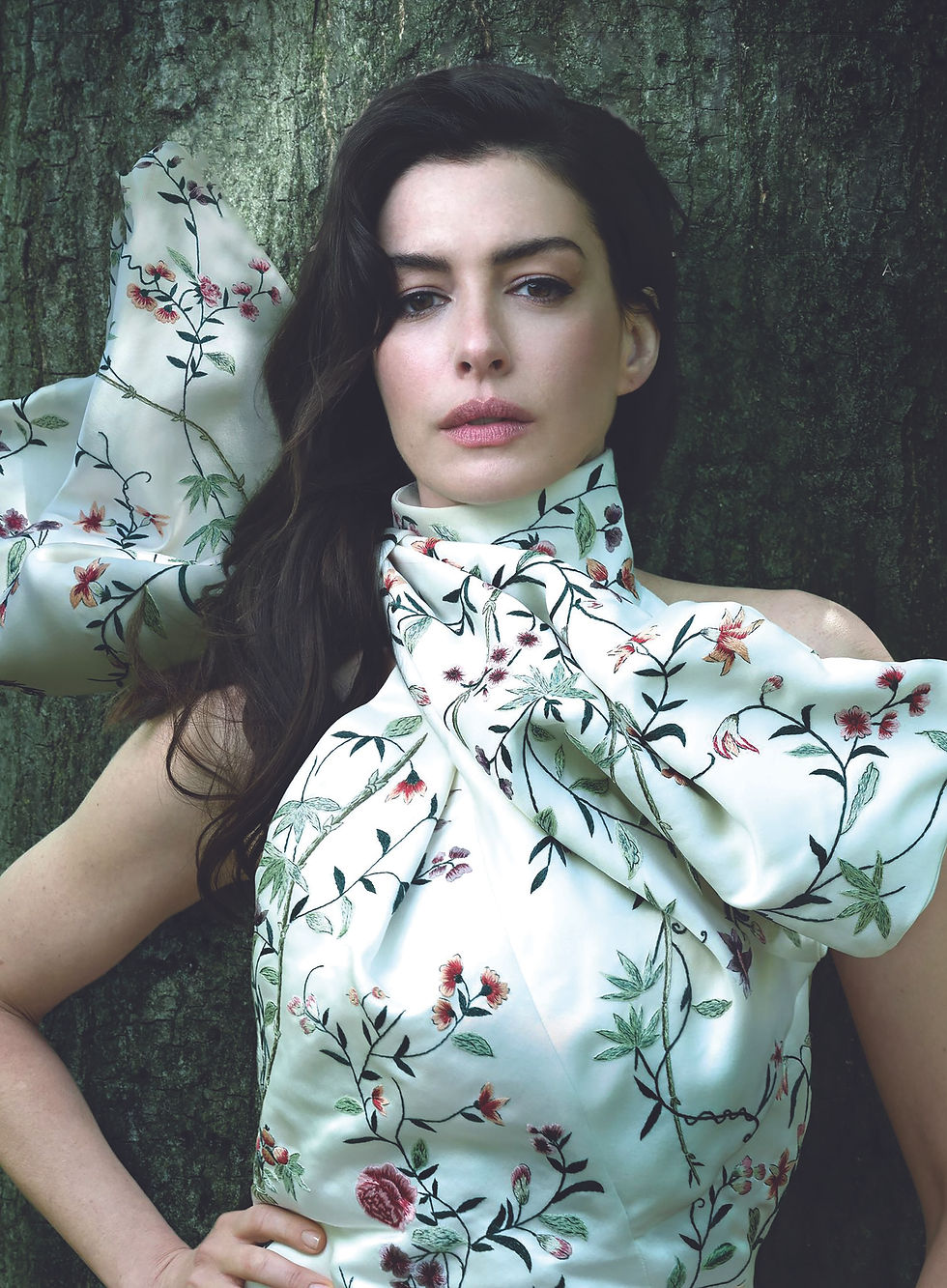
The world of magazines that serves as a backdrop for the first The Devil Wears Prada is slick and glamorous; the editor-in-chief has multiple assistants, and all of them are somehow dripping in Chanel and, naturally, Prada. This sequel is set in the current media landscape – one that I know from my lived experience is starkly different from what it was in 2006. Andy Sachs has returned to Runway as the magazine’s features editor (the role that usually oversees cover stories like this one).
“The characters are obviously 20 years along in their careers and at very different places, and the world of media is in a very different place,” says the film’s director David Frankel. “Andy has had a career in journalism that mirrors a lot of people’s experiences in journalism these days.” If that’s true, then Andy has survived lots of rounds of layoffs. And if The Devil Wears Prada was a bildungsroman with a makeover scene so aspirational that it inspired legions to work in fashion, the sequel, Frankel says, “is a movie about a woman in her 40s … [that’s] about how you make peace with the world as you find it, not the world that you wish existed”.
The other thing that is different about The Devil Wears Prada 2 is that it was made, as Hathaway puts it, “in view.” The first movie was such an unknown quantity that fashion brands were initially hesitant to get on board and lend clothes.
This time, the cast attended actual fashion shows during Milan Fashion Week. That was a first for Meryl Streep, who says she was “struck by how not only beautiful and young—everyone seems young to me – but alarmingly thin the models were… I thought that all had been addressed years ago. Annie [Hathaway] clocked it too,” Streep adds, “and she made a beeline to the producers about it, securing promises that the models in the show that we were putting together for our film would not be so skeletal! She’s a stand-up girl.”
Filming was a spectacle. “Even though we were aware of the impact of the first film two decades ago, I think none of us were prepared for the ambush of both goodwill and avid attention that engulfed us,” says Streep. “We needed police barriers and crowd control. Buses of fans turned up, and paparazzi swarmed and in one case kept jumping in front of the camera and the shot and got in a kerfuffle with crew! Annie kept her cool, but I was unnerved.”
During one scene, Hathaway took a spill down some steps after a heel snapped. “I was aware that I was falling, I was aware that I was being photographed, and I was also aware that, like, so many people on the crew, their hearts had just jumped up into their throat, so I needed to get up quickly to make sure they knew I was OK,” she recalls. She jumped up immediately after, with her arms outstretched like a gymnast finishing a routine, to let everyone know she was okay. But privately, she told Frankel, “Oh no. I’m news.”

Hathaway has been that kind of famous – where a stumble, literal or not, makes headlines – for most of her life. She tells me about having a conversation with an actor she reveres who told her, “We’ve watched you grow up.” “I’d never thought about it like that,” Hathaway says. “It’s funny to have met people when you were a teenager and grown in plain sight.”
In many ways, Hathaway is a perfect millennial avatar. Her mother was an actor who performed in regional theater productions, and she knew early on that she wanted to follow in her footsteps. She grew up the middle child and only girl of three children in Millburn, New Jersey, close enough to New York that she could take the train into the city to go on auditions for commercials. “I would go to school, and then I would get out at 2.22pm and I would sprint to the train station,” she recalls. Hathaway began doing that her freshman year in high school, while she was also performing with her town’s local theatre, Paper Mill Playhouse. At age 16, she landed a part on a family TV drama called Get Real and moved to LA. The following year, she booked the role of Princess Mia Thermopolis in The Princess Diaries, the other duckling-to-swan story that, along with that of Andy Sachs, became a canonic cultural touchstone for a generation.
“I feel like I was, like, everybody’s babysitter,” Hathaway says of the loyal fans who watched her in those early projects. “And I was a child when I made The Princess Diaries. I was still a 22-year-old mess of a human when I made The Devil Wears Prada. And so, we’ve grown up together, and I’m so happy for them and how their lives are unfolding. Like, this crazy thing where people just graduate from high school and they just send me their graduation announcements. People send me their wedding invitations. It’s so very sweet. And I feel bad, because I can never do anything with them, because I’m not Taylor Swift–level organized. Maybe someday.”
I really loved this deep dive into Anne Hathaway’s evolution—both as an actress and as a person navigating the pressures of fame and family. The shift from chasing “balance” to seeking “harmony” really resonated with me. It’s such a simple reframe, but it feels more realistic for anyone trying to juggle multiple roles without burning out. I also appreciated the behind-the-scenes details about the sequel, especially how Hathaway advocated for healthier model standards on set. It’s refreshing to see her using her platform thoughtfully. On a totally unrelated note, I recently used an image sharpener online to clean up some old family photos, and it worked surprisingly well—felt like a small victory in my own quest for clarity.
Details often make the biggest difference when expectations are high, because small choices can affect the overall result more than people realise. Good outcomes usually come from preparation, consistency and noticing issues before they become bigger problems.
That same attention to detail matters in construction management, where quality checks, sequencing, site records and subcontractor coordination all need to be managed carefully. NVQ Level 6 Construction Site Management Answers can be useful for seeing how those responsibilities are explained through real project examples.
I was going through some academic discussion threads and noticed how often students struggle with history coursework, especially when the analysis starts getting more complex than expected. Someone casually mentioned History Assignment Writing Help in the middle of the thread, and it made sense because sometimes you just need a different explanation style to understand things properly. History itself isn't impossible, but it does feel demanding with sources and interpretation, so even a small mistake can throw off the whole argument. I keep running into issues where I understand the events but fail when structuring an actual essay, especially with linking causes and consequences. It gets a bit frustrating when organizing evidence takes longer than writing the essay itself. Still,…
Read "Anne Hathaway: The Devil's in the Details" a moment ago, and the structure made the key ideas easy to follow. Looking forward to reading more like this. mobile fps test
Letra Diferente é uma excelente escolha para quem deseja destacar textos em redes sociais. Crie mensagens criativas e personalize conteúdos utilizando estilos únicos e modernos facilmente.