


Homeschool, but Make it Fancy
In April 2024 Jackie Barba, a mother of two girls, heard about Alpha School, a new, artificial intelligence–supported educational institution that was slated to open in her home city of Miami for the 2024–2025 academic year.
At $50,000 per year, the school’s cost rivaled that of high-end private institutions found mainly in New England. But unlike its legacy rivals, Alpha (which was founded in Austin, Texas) promised a more modern and real world–applicable learning platform, one where, Alpha claims, technology helps cram a day’s worth of academics into a two-hour window, thus opening up the rest of the day for a student’s personal progress, skill-building, and social development.

Barba had always made sure that the education her daughters received was most appropriate to their learning styles. During the Covid pandemic, she and her husband pulled their preteen girls out of a Montessori school. They set up a classroom in their house, made their girls wear uniforms, and hired a private teacher, who came to their home and taught their daughters in a hyperpersonalized setting. Barba became less worried about grades and test scores, focusing more on her daughters’ passions and worldly development. The family traveled a lot, both domestically and internationally, and brought the teacher along with them. “We made it very structured, and we thought, It can’t get better than this,” Barba says.
But Alpha piqued her interest. The school is at the center of emerging learning modalities that have begun to infiltrate the way parents plan their kids’ educations. What’s more, many of the country’s richest and most powerful people have been evangelizing that there’s a better way to educate children. It has been hard to miss the headlines that have popped up over the past half-decade: Meta founder Mark Zuckerberg (himself a Harvard dropout) and his wife Priscilla Chan founded a tech-forward learning platform, Summit Learning. (The couple also set up a pandemic-era homeschooling pod that included their daughters and a dozen other local children.) Elon Musk has been a vocal critic of traditional education, and Alex Karp, CEO of the defense tech company Palantir, recently lamented that a Yale graduate with no specialized knowledge or applicable skills is “effed.” Palantir has even launched an alternative to higher education: Meritocracy Fellowship, which will be, Karp claims, the antidote to the “platitudes” taught at traditional universities.
These are the most visible examples of public figures bucking the traditions of legacy education, but it’s not just a few rogue billionaires seeking out new and arguably more effective learning ideologies. Many upper-middle-class parents—like Jackie Barba—are giving equal weight to emerging schools and educational systems. Alpha itself has used its AI-driven methods (and tech-fueled marketing shtick) to entice wealthy parents, who would normally send their kids to high-echelon private schools like Andover or Dalton, to try out a school that, Alpha claims, will better prepare their child for adulthood. Whether the tech track is truly more beneficial than the legacy route hasn’t yet been settled, and a fierce debate over its efficacy has begun. On one side, some AI-school parents humblebrag their kids’ progress on X; on the other, press reports have emerged questioning methodologies and stated results.
Barba went to an educational seminar hosted by MacKenzie Price, Alpha’s co-founder, who graduated from Stanford and “always knew that education needed revolution,” according to her website. Price explained the philosophy behind her school, namely that traditional education does not adequately prepare students for the modern world. Barba was struck by how much Price’s values mirrored her own. But she had a question: “MacKenzie, what is the attendance policy?” Barba’s best memories were made while traveling with her kids and not adhering to a strict educational calendar. She didn’t want to give that up.
Price replied that Alpha doesn’t have a mandatory attendance policy, because the students can take their laptops and do their work from wherever they are. Then Price smiled. “But I have a feeling they’re going to love school so much that they’re not going to want to take a vacation.”
Barba was skeptical about that, but she was captivated and decided to enroll her children in the fledgling Miami campus. “These girls need to learn things to be ready for the real world,” Barba says, adding that she also wants her daughters to have unique attributes that may stand out to college admissions departments, should they choose to pursue higher education. Her kids fell in love with it. “MacKenzie was correct,” Barba says. “We have spent more time in Miami, because they don’t want to miss a schoolday.”
The helicopter parents of yesteryear—with their zealous dedication to extracurricular activities, 4.0 GPAs, and perfect SAT scores—still exist, but they are slowly being superseded by parents who are skeptical of legacy education and obsessed with optimizing their children for a society increasingly influenced by, and reliant on, technology. They’re asking: Is our education system too antiquated and mired in Kafkaesque bureaucracy to adequately prepare children for the demands of modern society? Is there a better way?

Parents have reason to worry about their kids’ future. Beyond labor market considerations—artificial intelligence has begun to supplant entry-level jobs, leaving recent college graduates with a 5.6 percent unemployment rate—the efficacy of public education in America isn’t very reassuring. A national teacher shortage has led to more kids in each classroom, which has led to teachers across the country going on strike to lower class sizes so they can do their jobs more effectively. And learning gaps born of the pandemic have proven stubbornly difficult to rectify.
In some pockets of the country, there has even been an exodus from the public school system. In Massachusetts, for example, a Boston University study found that public school enrollment had declined by 4 percent since 2019, with the largest drops coming in the state’s wealthiest areas. Private school enrollment has sustained its Covid-era bump, and competition for coveted slots at Ivy League colleges has increased, leading schools to look to attributes beyond academic excellence. “They’re tired of the same thing,” says Katie Rybakova, associate professor of education and chair of the Lunder School of Education at Thomas College, in Maine. “They want to hear the story of someone who has taken a risk and failed, and what they did to shift—what this person experienced that is different, that will help them succeed in a world where interpersonal relationships and resiliency and persistence are going to be highly valued.”
A new sense of urgency has entered the educational conversation. Parents are beginning to feel that their children are up against greater odds, and the status quo may not cut it in preparing them for an ever evolving world. The archetype of the Ivy-bound, overachieving middle-schooler is starting to lose ground to a value system that prioritizes applicable life skills over academic rigor and technical acumen over AP classes. If Ivy League schools, coveted internships, and high-paying white collar jobs all demand something different from what legacy education provides, shouldn’t parents at least consider other options for their children?

In the 1970s educational theorist John Holt founded the modern homeschooling movement, which he hoped would push back against the traditional educational system, which existed only, he argued, to mold children into compliant employees. Although homeschooling expanded to encompass an array of participants—mainly those with a specific religious or political value system—institutional skepticism remained a constant in alternative education. Today proponents of homeschooling see it as a way to fully customize a child’s educational experience, which may explain why the practice is having a renaissance. The number of homeschooled K–12 students in America has more than doubled since 2019; these kids make up 6 percent of the total student population.
While a young homeschooler’s curriculum may mirror that of public school, a more customized plan can be implemented once students are ready for high school. “That’s when parents typically branch off and say, ‘Okay, how can I build on his or her strengths to be more adequately prepared for American society?’ ” says Lauren Farrow, founder of Schooling America, an AI-based education and homeschooling consultancy. Farrow explains that self-determination is at the top of the list for many families, especially those that take a more bare-knuckled approach to making sure their children fare better than others in their cohort. “I often talk to parents and families about how important it is to be a problem solver, because that works in a capitalistic society.”
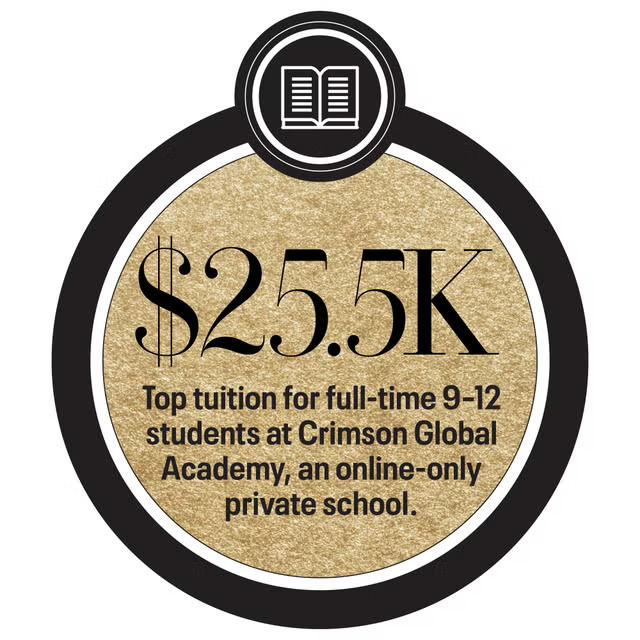
Online-only education has also increased in popularity. In 2019 college admissions consultancy Crimson Education launched Crimson Global Academy, an internationally accredited school that instructs students from more than 60 countries. Alyssandra Wei—who was born in Shanghai and raised in Auckland, New Zealand, and now studies physics at Williams College in Massachusetts—opted to enroll in Crimson over her local private schools. Wei enjoyed the autonomy of taking classes online. “There are many ways where I could learn faster and absorb more information on my own than sitting in a classroom,” she says.
Wei had a dynamic class schedule that was normally conducted between 10 a.m. and 4 p.m., although some of her classes were held in the evening (which freed up time that Wei filled with additional courses). Wei admits that she sacrificed the social aspects of an in-person high school experience for the benefits of online instruction, although she did her best to keep in touch with friends from her previous local school. With more time spent on her studies, Wei was able to include more academic specializations than required for her high school diploma. In 2023 she was valedictorian of her Crimson class.

Not all parents are eager to jump on the high-tech bandwagon, especially those living in places like New York City, Los Angeles, and Miami that have hypercompetitive private school cultures. “I don’t know a lot of people on the Upper East Side who want to have their kids be the guinea pigs,” says one Manhattan mother who recently scheduled and then canceled an appointment to visit Alpha’s new Financial District outpost. “The attitude is, Let’s wait and see.” Brooke Parker, an independent counselor who specializes in kindergarten and pre-K admissions at New York private schools, says her clients have been curious but still lean toward traditional options like Dalton and Trinity. “The education model is impressive, but the school is located in an office building downtown. It looks like a WeWork space. My fingers are crossed that they move to the Upper East Side, ideally in a beautiful, cozy building to offset the screens.”
Nonetheless, as traditional routes to prosperity look less certain, even for the upper class, people are more apt to try a more high-risk, high-reward route. “We used to have a set of norms [regarding education], and those norms are getting increasingly thrown out the window,” says Kevin Kinser, professor and head of the department of education policy studies at Penn State. “The ‘move fast and break things’ ethos has really migrated across the board, in that there are very few guardrails anymore for people making very drastic and dramatic changes to how education works and how people are prepared for work, family, and career.”
This includes the drastic step of removing your child from one of the most formidable private schools in the country in favor of an institution like Alpha. For Alana and Peter Ackerson—the former a serial technology entrepreneur and former CEO of the Thiel Foundation, the latter a venture capitalist and co-founder of Audere Capital—the decision to pull their three daughters out of Sacred Heart Greenwich, one of Connecticut’s premier private all-girls schools, was born of necessity. “When we thought about what we believed the future is going to look like,” Alana says, “shaped by AI, entrepreneurship, a lot of change, and interesting ambiguity—we wanted to make sure that they were building up a skill set that would allow them to navigate the world with critical thinking and emotional intelligence, as much as academics.”
To be fair, the Ackersons were early adopters of a contrarian and critical disposition regarding legacy education. While at the Thiel Foundation a decade ago, Alana (despite being a Stanford graduate) oversaw the Thiel Fellowship, which provides grants to students who have decided to forgo or drop out of college to try their hand at entrepreneurship. For his part, Peter says he came to realize how much of the energy employed by legacy schools “is dedicated toward compliance, toward conformity, and toward consistency, which is just getting everybody to a minimum standard.”
After visiting Alpha’s Austin campus and seeing how much their three daughters enjoyed what the school had to offer, the Ackersons enrolled their kids and moved to Texas at the start of the 2024–5 school year. “The objective of education should not simply be to get into a school that may or may not be a good fit for you but has some type of prestige,” Peter says, “but rather whether education equips you to solve the challenges in your lived reality, in your life, in your communities, and in the world.”
This mindset—that the world needs to be fixed, and training children to become altruistic problem solvers is the best way to optimize the future—is at the center of this philosophical shift in education. “We have an educational system that has been around since the Industrial Revolution, and we’re starting to realize that there are really massive fissures in that. AI is only accelerating how much those are cracking,” Rybakova says.
To date, the use-case of AI as a foundation of the educational landscape has not been clearly defined. Is it just a tool to make education more efficient and effective, or will it have a larger role? “We are a year or two away from someone proposing a fully AI university,” Kinser says. “I believe that that institution will get accredited in some way, shape, or form, and we’ll have those as other kinds of options for students to choose from.” Despite the promises of technology, Kinser warns, we cannot become complacent about the potential pitfalls of AI. “A calculator is always going to say two plus two equals four. AI may not, depending on the kind of prompt that it’s given,” he says.
Jackie Barba was thrilled to see how Alpha was including AI in the education of her daughters, who are now 15 and 13 and about to finish their second year at the school. When they first enrolled they were lagging their peers in certain areas, but Alpha’s testing rubric was able to identify specific knowledge gaps. “My little one is in seventh grade, but she’s in ninth grade language. My older one is in ninth grade, but she’s in 12th grade reading.”
Beyond what she perceives as Alpha’s efficiency, Barba credits its gamification of education for keeping her daughters engaged. For example, younger students are able to earn Alpha Coins, which have real-world value and can purchase items from the school store. Students also have Alpha Rings, which digitally rack up points the more the students accomplish. “They’re self-motivated, with self-imposed goals,” Barba says.
She believes her daughters’ progress via Alpha is proof that the legacy education system in America needs to change. She also thinks about her nephew, who followed the well-worn path of the overachiever: varsity sports, straight A’s, church every Sunday, community leadership. “He was the perfect student for these Ivy League schools, and he did not get into any of his top choices, because he didn’t stand out,” Barba says. “There were so many amazing boys just like him that were at the top in every single way. But what makes you special? You want those top schools to say, ‘Oh, you’re amazing, but you also have this one more thing that really makes you stand out.’ ”
Fifty grand a year for AI tutors in Miami—that’s basically the tuition of a small yacht, but I’m curious if the algorithm can handle a kid’s “I forgot my homework” excuse better than a human teacher. I’ve been digging into how these hybrid models actually work, and the cost breakdown is wild—check out https://cometly.pro
Fifty grand a year for AI tutors in Miami—sounds like the same old private-school arms race, just with a chatbot instead of a lacrosse field. I’ve been digging into how the tech actually works, and the curriculum breakdown is wild—check out https://hi3d.pro
Fifty grand a year for AI-led learning in Miami—that’s a serious flex, but I’m curious how much human mentorship actually sneaks into that "modern" model. I’ve been digging into cost breakdowns for alternative schools like this, and the real price tag might be the loss of old-school social scaffolding. Check out https://grok-ai-video.com
$50k for AI-assisted learning feels like paying luxury prices for a beta test, but if it actually frees up teachers to mentor instead of grade, maybe that's the future. I've been digging into how AI tools compare for homeschool setups and found some surprising options. https://arcadeai.pro
$50k a year for AI tutors is certainly one way to make homeschool bougie, but I’m curious how much of that fee actually goes to human oversight versus just the algorithm. I’ve been digging into the cost breakdown myself, check out https://stablevideodiffusion.net